2026 Wildfire Season: How to Keep Your Home Safe in Canada
Canada's 2025 wildfire season was the second worst ever. Plain-English guidance on sealing your home and which CADR keeps indoor PM2.5 below 12 µg/m³.
With 108 active wildfires burning across Canada in May 2026 already, this is shaping up to be another severe season. Here's a practical, evidence-based guide for keeping your home safe — from sealing your space to choosing the right CADR.
Canada's wildfire problem is getting worse
The 2025 season burned 8.78 million hectares — the second-worst since records began in 1972. Three of the five worst seasons in Canadian history have occurred since 2023. Climate projections suggest fire seasons will lengthen by 2–3 weeks per decade through 2050 across BC, Alberta, Saskatchewan, and Ontario.
The air quality impact reaches far beyond the fire zones. Canadian wildfire smoke has repeatedly caused "Unhealthy for Sensitive Groups" and worse air quality across every major Canadian city, and as far south as New York and Chicago.
What are the indoor air quality targets?
| PM2.5 (µg/m³) | AQHI+ range | Health Canada risk | Action |
|---|---|---|---|
| < 12 | 1–3 | Low | Normal activity |
| 12–35 | 4–6 | Moderate | Sensitive groups reduce outdoor time |
| 35–55 | 7–8 | High | Run purifier; close windows |
| 55–150 | 9–10+ | Very High | Seal home; run purifier at max 24/7 |
| > 150 | 10+ | Extreme | Evacuate if persists; wear N95 indoors |
How smoke enters your home
Even a "sealed" house leaks air. Canadian homes average 0.3–0.5 natural air changes per hour (ACH) — meaning the entire air volume turns over roughly every 2–3 hours through:
- Window and door gaps (largest contributor)
- Bathroom and kitchen exhaust fans (run them — they push smoke out)
- HRV/ERV systems — switch to recirculate mode during smoke events
- Clothes dryer vents
- Wall and floor penetrations (PM2.5 particles are small enough to pass through most caulking)
The sealed bedroom strategy
When outdoor AQI exceeds 7, concentrate your protection where it matters most: your sleeping space. Seal one bedroom with door draft stoppers, run your HEPA purifier at medium-high (not max — noise matters for sleep), and keep the door closed.
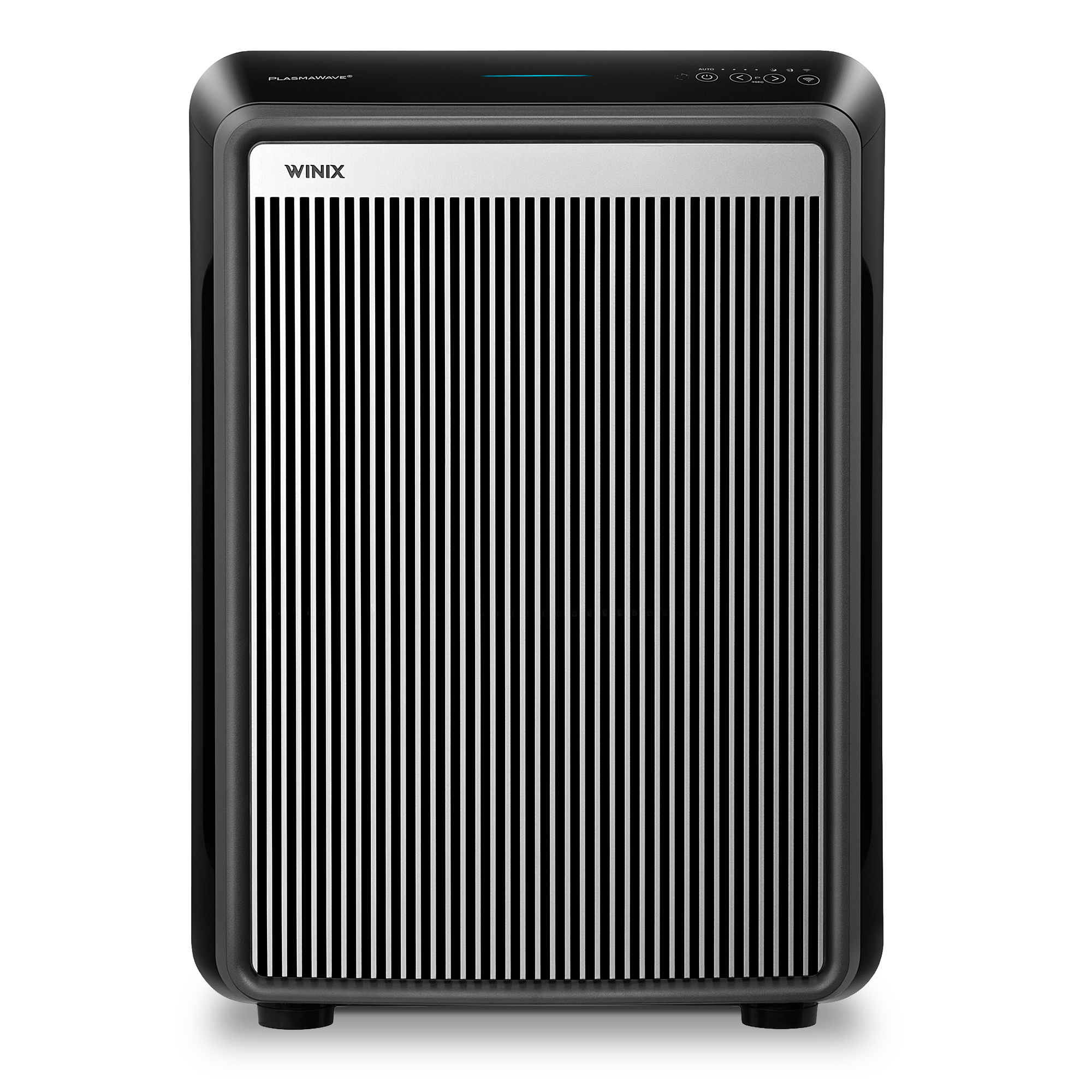
Target: Run the purifier for 30 minutes at max to "scrub" the room, then drop to medium for quiet overnight operation. A Winix C545 on Speed 3 runs at 43 dB — quieter than a desk fan — while maintaining meaningful air changes.
Which Winix for smoke season?
- Single bedroom (under 250 sq ft): Winix C545 — 232 CFM, Costco $149.99, quietest at low speeds.
- Master bedroom or home office (250–380 sq ft): Winix C610 — 248 CFM, all-in-one annual filter, Wi-Fi app for remote scheduling.
- Large living room (380–500 sq ft): Winix C909 — 323 CFM smoke CADR.
- Open-concept main floor (>500 sq ft): Two C610s, one at each end. More cost-effective than a single oversized unit.
See all Winix reviews
Every model sold in Canada — independently tested with real CADR data.
Browse All Reviews